FoundryOS: An Automated Software Engineering Department
From intent to the platform your business runs on.
Sections
- CODE GENERATION IS NOW THE FAST PART
- CODE GENERATION IS ONE DEPARTMENTAL ACTIVITY
- WHAT AN AUTOMATED ENGINEERING DEPARTMENT HAS TO OWN
- WHEN A CREWOS FAILURE BECAME A FLEET-WIDE CONTROL
- FOUR MORE FAILURES THAT BECAME CONTROLS
- FROM INTENT TO THE PLATFORM
- ENOUGH STRUCTURE FOR THE WORK
- THE BUSINESS GETS MORE THAN AN APP
- WHAT THE ARCHITECTURE PROVES, AND WHAT IT DOES NOT
- THE DEPARTMENT AROUND THE MODEL
- Keep reading
- Evidence
A capable model can produce a working screen in minutes.
A business does not run on screens.
It runs on permissions, responsibilities, handoffs, exceptions, records, infrastructure and consequences. The application has to match the way the business actually works. The database has to exist outside the repository. External services have to be connected. The right people need the right access, and only that access. Important workflows have to reach their real end. The platform has to survive the model session that created it.
AI has made code abundant. It has not made those responsibilities disappear. It has made them easier to skip.
That is the work FoundryOS is built to perform.
I spent close to two decades in construction management before I started building software, and one lesson followed me over: nobody on a job site confuses the drawings with the building. In software, that confusion happens every day. AI has made it faster.
FoundryOS is an operator-governed, automated software engineering department. It turns business intent into the platform the business runs on, then keeps that platform connected to reality as the operation changes.
The operator in that sentence is not a metaphor. It is the accountable human directing the department and holding the decisions that carry real consequence. In FoundryOS today, that operator is me.
A department is not a collection of agents. It is a set of responsibilities capable of carrying intent all the way to an evidenced operational result.
Automated does not mean ungoverned. Models reason and implement inside explicit business and operator authority. Deterministic machinery controls state, evidence and known invariants. Humans keep the consequential decisions.
Principle: The model is not the system. It is intelligence operating inside one.
CODE GENERATION IS NOW THE FAST PART
Consider a commercial-services company. It is representative, assembled from patterns I have encountered across real small-business work, and if you have ever run a service operation it will feel familiar.
Work arrives through phone calls, emails and messages. Scheduling lives in a spreadsheet with a colour code only one person fully understands. Staff updates arrive in a group chat, mixed in with everything else a group chat carries. Customer history is split across inboxes, the accounting records and the owner's memory. Invoices are reconstructed after the work is finished. Exceptions are handled by asking whoever has been there the longest.
The owner asks for an app.
The request sounds simple because years of operational complexity have been compressed into two words.
A modern coding model can turn those two words into something impressive before lunch. A login screen. A dashboard. A customer list. A calendar. A work-order form. Convincing sample data in every field. For a moment, the company looks like it has already crossed the gap from spreadsheets to software.
The screen may be real. The victory may still be false.
Because now the real questions start. Who can create a job? Who can change its price? Can a technician see every customer, or only assigned work? Can one customer's records appear in another account? What happens when a schedule changes after the notification has already gone out? Which system is authoritative for payment status? Can the owner correct a record without destroying the audit trail? Were the database security policies actually applied to production, or only written into a migration file? What happens if the deployment succeeds but the webhook was never registered? And who decides whether an incomplete workflow is a defect, a missing requirement or a future feature?
Those questions are not edge cases around the software. They are the software.
Generating visible implementation is now far faster than establishing operational completeness. The demo arrives early. Done arrives late. The distance between the two is where businesses get hurt, because speed makes it easy to mistake progress for completion.
CODE GENERATION IS ONE DEPARTMENTAL ACTIVITY
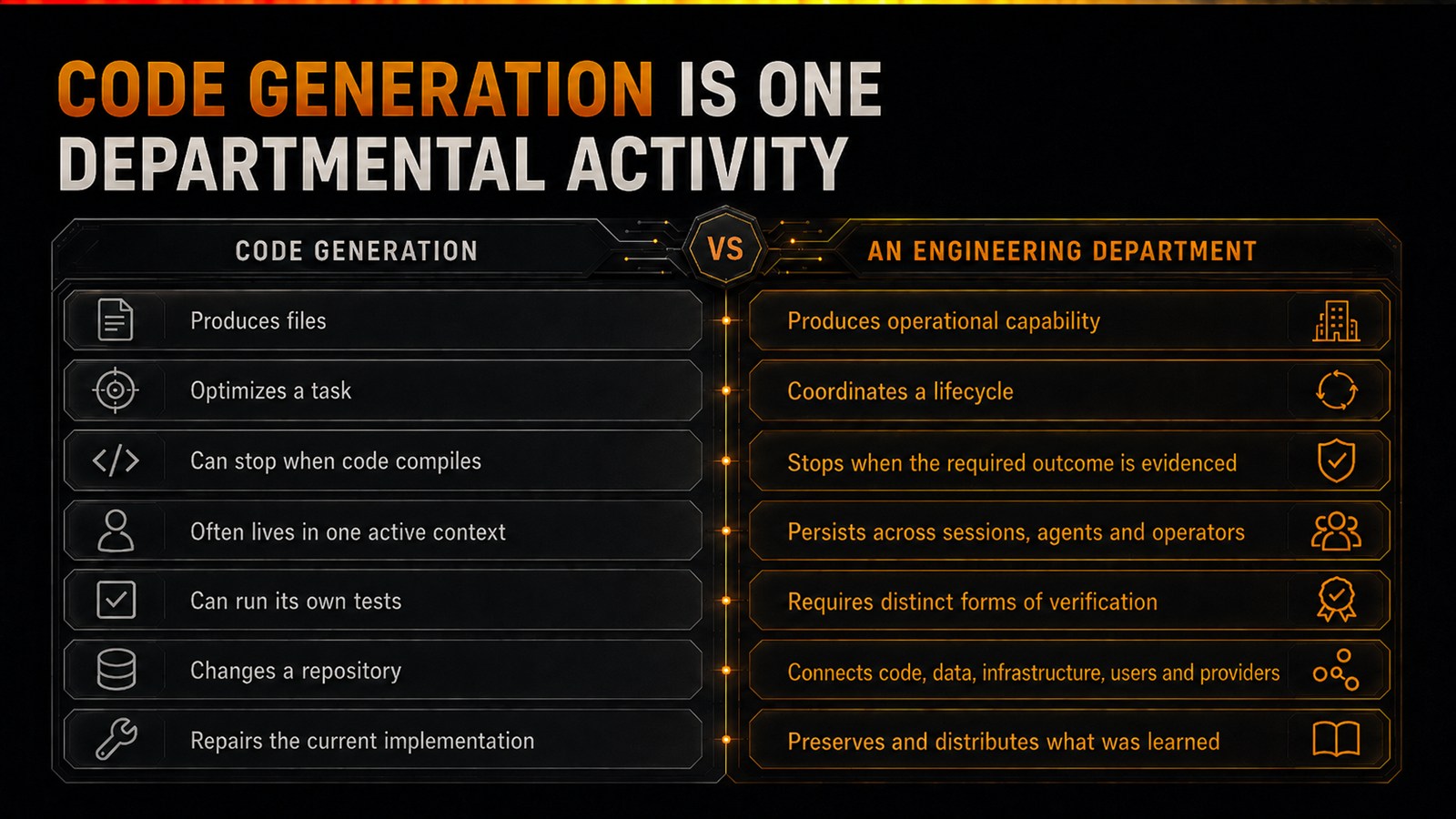
Code generation matters. I want to be clear about that, because nothing in this article argues against the model. It argues against leaving the model alone with the job.
Code generation is one activity inside software engineering.
| Code generation | An engineering department |
|---|---|
| Produces files | Produces an operational capability |
| Optimizes a task | Coordinates a lifecycle |
| Can stop when code compiles | Stops when the required outcome is evidenced |
| Often lives in one active context | Persists across sessions, agents and operators |
| Can run its own tests | Requires distinct forms of verification |
| Changes a repository | Connects code, data, infrastructure, users and providers |
| Repairs the current implementation | Preserves and distributes what was learned |
A coding agent can be an exceptionally capable worker. It does not automatically become the business analyst, the architect, the engineering manager, the infrastructure operator, the security reviewer, the QA system, the release authority and the institutional memory, all at once, inside one context window.
Giving all of those responsibilities to one model does not remove them. It hides them inside one probabilistic process.
FoundryOS makes the responsibilities explicit.
Principle: Models provide intelligence. FoundryOS turns that intelligence into a governed production operation.
WHAT AN AUTOMATED ENGINEERING DEPARTMENT HAS TO OWN
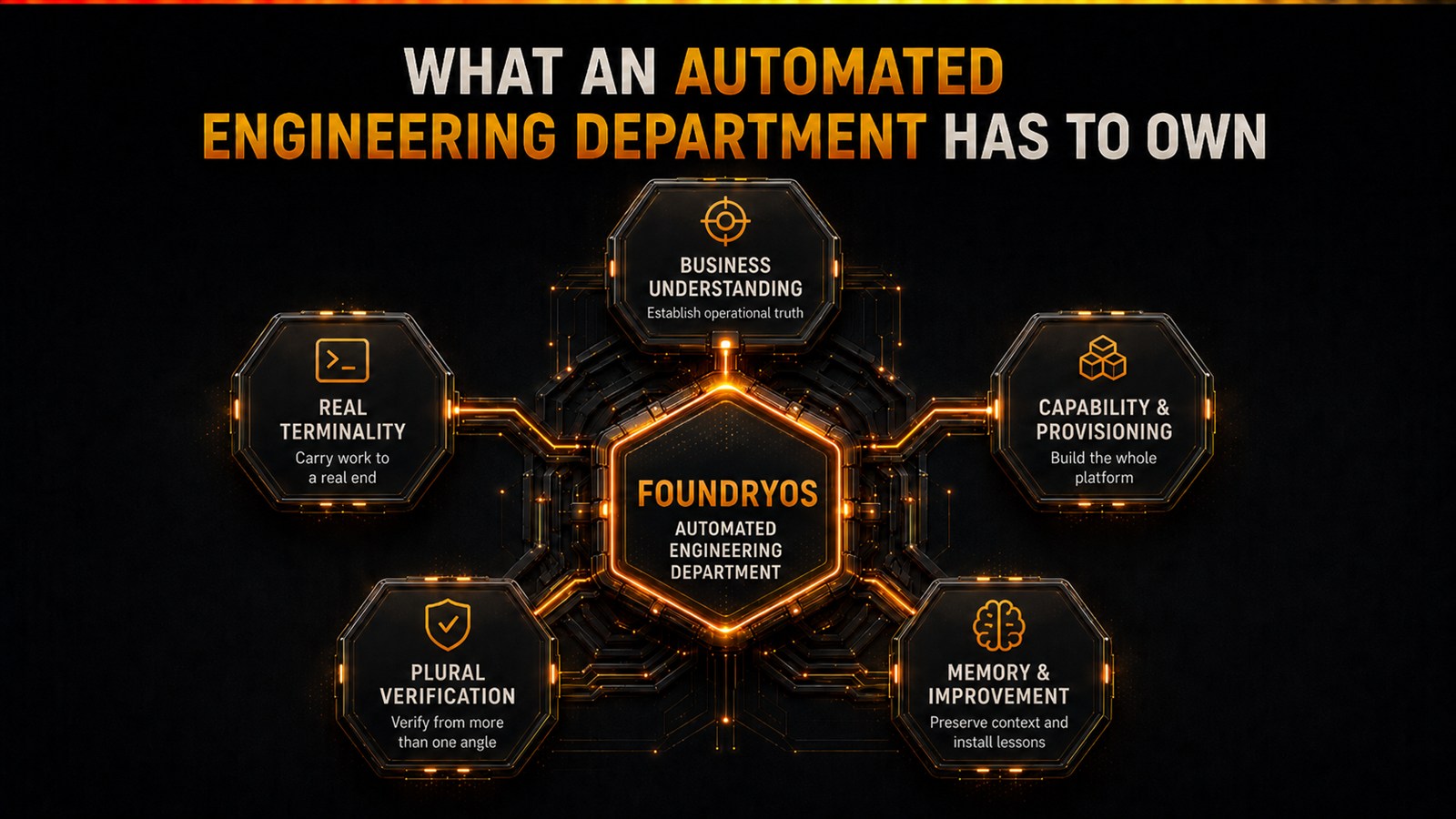
Five responsibilities sit around the intelligence. FoundryOS has to own all of them.
It has to understand the business
A business does not arrive as a clean technical specification. It arrives as symptoms, workarounds, contradictory documents, unwritten rules and people who each understand a different part of the operation.
I have sat in enough operational meetings to know the pattern. The formal process and the way work actually moves are rarely the same thing. The gap between them is exactly where software projects fail.
So the first job is not to generate software. It is to establish operational truth.
The questions themselves are plain: what work exists, who performs it, which records matter, where handoffs fail, which system is authoritative, which exceptions are legitimate, which decisions belong to the owner, and what the platform should improve without quietly changing the business into something it never agreed to become.
FoundryOS converts that material into canonical build authority. The builder should not be rediscovering business policy while writing code.
It has to carry work to a real terminal state
A model can say it completed a task. That statement is useful. It is not a terminal condition.
I learned that in production. In one session, Claude wrote that 225 cells remained and said it was continuing. Then it stopped. The instruction was already clear. Nothing enforced it at the boundary where the turn ended.
Completion has to exist outside the conversation.
The requested capability exists. The workflow reaches its real end. The database matches the application. External services are connected. Unresolved items are visible instead of forgotten. Evidence exists. The release state is known.
For small, bounded work, FoundryOS can use a lightweight continuation contract. For significant engineering work, it can use a durable, multi-stage execution lifecycle. The amount of process scales with the work. The completion requirement does not.
Principle: Partial progress is a state. It is not a synonym for done.
It has to build and provision the whole capability
Building the app but not provisioning the platform is how a business ends up with a convincing interface that nobody can safely depend on.
A complete capability can also require database schema, row-level security, authentication, hosting, deployment configuration, provider accounts, domains, secrets, monitoring, migrations, mobile readiness, and backup and recovery procedures.
A repository can contain the correct code while the business still has nothing dependable to operate.
FoundryOS treats infrastructure and provider state as part of the engineering result, not as chores left over after the application is declared finished.
It has to verify the result from more than one angle
Correctness is plural. Runtime behaviour, structural quality, promise-versus-implementation alignment and infrastructure state can each succeed or fail independently.
The agent that wrote the implementation can explain what it did and hand over evidence. It should not be the sole authority deciding whether its own evidence is sufficient.
Different systems ask different questions:
- Does the running application behave correctly?
- Is the implementation structurally sound?
- Does the result match the business promise?
- Does the infrastructure actually exist outside the repository?
- Can a separate reviewer find a problem the known rules did not anticipate?
One passing test cannot answer all of them.
It has to remember and improve
A model session can hold an enormous amount of context. It still ends.
The next worker needs the architecture, the data model, the business decisions, the deployment procedure, the known failure modes and the reasons the important controls exist. That knowledge cannot depend on reconstructing old conversations.
FoundryOS preserves project context and reusable engineering lessons in durable artifacts. More importantly, when a preventable failure appears, the system itself is expected to change.
Principle: Fix the failure. Then fix the system that allowed it.
That principle is the main engineering idea behind FoundryOS. Everything else in this article is that principle applied.
For the commercial-services company, these five responsibilities are the difference between receiving a dashboard and receiving an operating platform. A reschedule should update the worker's day, preserve the previous appointment, trigger the right customer communication and carry the change into billing, without depending on the owner's memory at any step.
WHEN A CREWOS FAILURE BECAME A FLEET-WIDE CONTROL
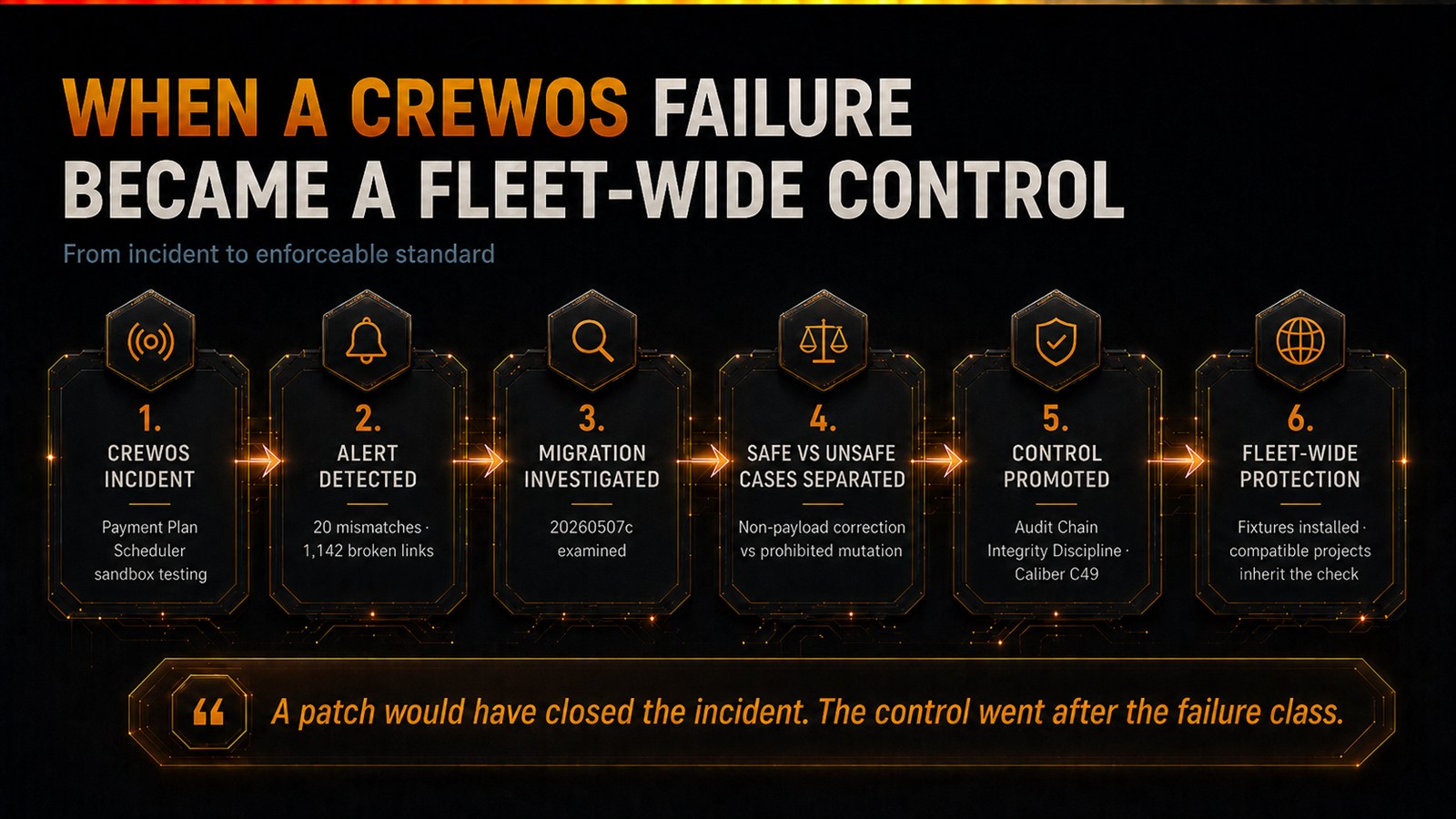
The commercial-services company is representative. What follows is not. It is a recorded incident from CrewOS.
Earlier I asked whether an owner can correct a record without destroying the audit trail. This is that question with the hypothetical removed.
During sandbox testing of the Payment Plan Scheduler, an audit-chain verifier reported 20 mismatches and 1,142 broken links.
On an audit chain, those numbers demand attention. An audit trail you cannot trust is worse than no audit trail, because people keep making decisions on top of it.
The investigation traced the finding to migration 20260507c, which had retroactively updated entity_label_snapshot and actor_label on historical audit events.
The protected cryptographic payload had not been touched. Those labels sit outside the hashed content. The verifier was detecting historical-row mutation under a broader integrity rule, not proving that protected event payloads had been rewritten.
So the alarming reading and the actual damage were two different things. That distinction mattered.
The underlying pattern mattered more. Historical audit rows were being changed without a governed rule separating permitted non-payload corrections from prohibited mutation. A future reviewer looking at a historical update should never have to guess whether it was harmless.
The immediate issue was documented in CrewOS. Then the response moved beyond CrewOS.
The lesson became the fleet-wide Audit Chain Integrity Discipline. Caliber, the registry of engineering criteria that FoundryOS work is scored against, gained criterion C49 to keep the rule installed. Fixtures were added for allowed, forbidden, warned and grandfathered migration patterns. In compatible projects in the current FoundryOS environment, any migration that updates protected audit payloads, deletes audit rows or alters historical labels without explicit annotation is now surfaced mechanically.
Every compatible project inherits that check. The next operator does not have to remember the rule for the protection to exist.
A patch would have closed the incident.
The control went after the failure class.
FOUR MORE FAILURES THAT BECAME CONTROLS
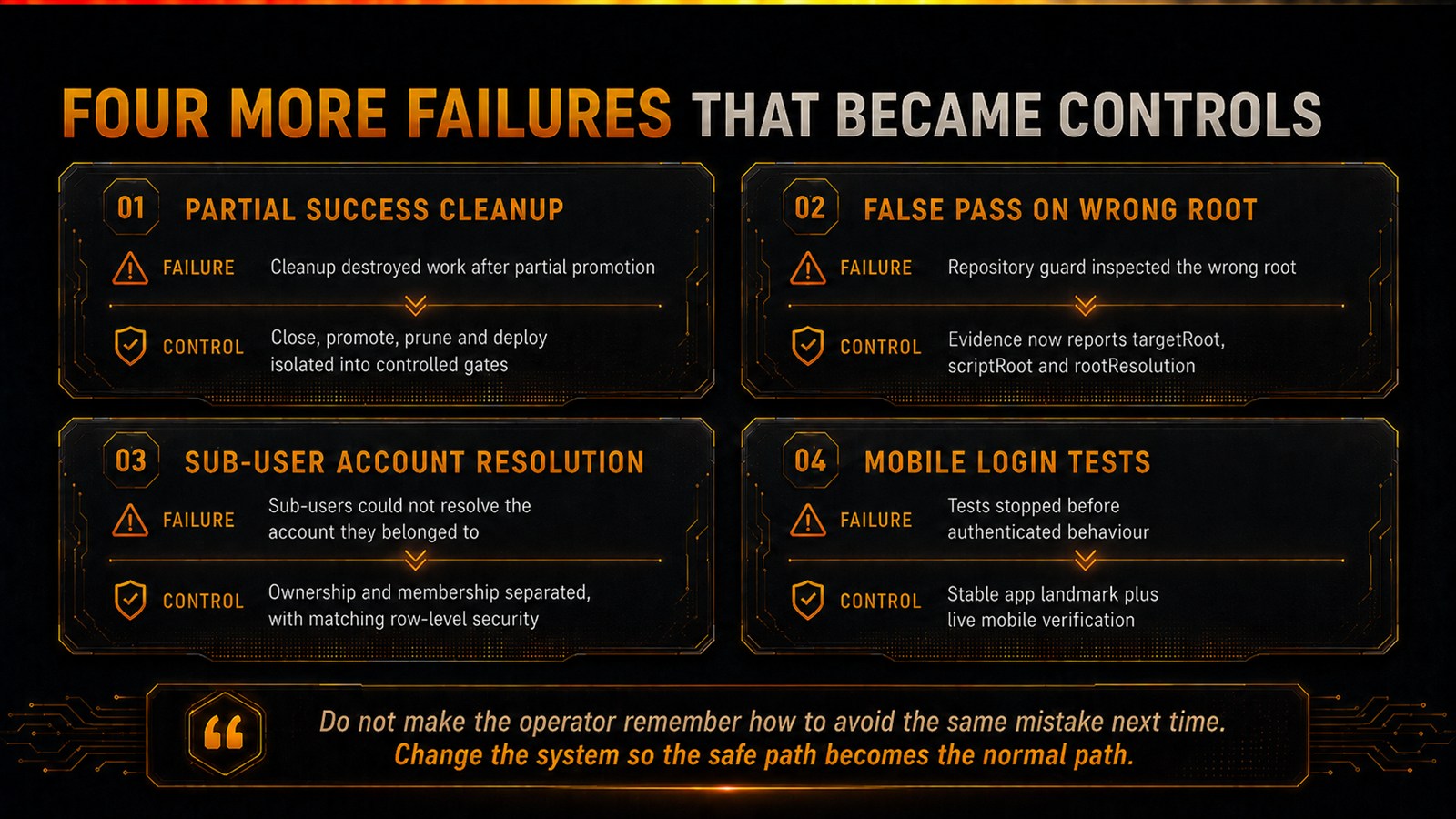
The same reflex shows up across construction, testing and release.
- Cleanup destroyed work after a promotion reached partial success. Close, promote, prune and deploy are now separate controlled gates, source reachability must be proven before cleanup runs, and Caliber C112 keeps the separation installed.
- A repository guard returned
PASSwhile inspecting the wrong root. The control now resolves its target from the active working context and reportstargetRoot,scriptRootandrootResolutionas evidence, so a pass names exactly what it inspected. - Sub-users could not resolve the account they belonged to. Converter doctrine now separates ownership from membership, resolves owners through the account record, falls back through the user profile and membership path for sub-users, and pairs both paths with matching row-level security.
- Mobile login tests stopped before reaching authenticated behaviour. The success contract now uses a stable, breakpoint-independent application landmark, followed by live mobile verification and Cell coverage.
None of these failures would have appeared on the owner's screen. Every one of them would eventually have appeared in the owner's business.
Principle: Do not make the operator remember how to avoid the same mistake next time. Change the system so the safe path becomes the normal path.
FROM INTENT TO THE PLATFORM
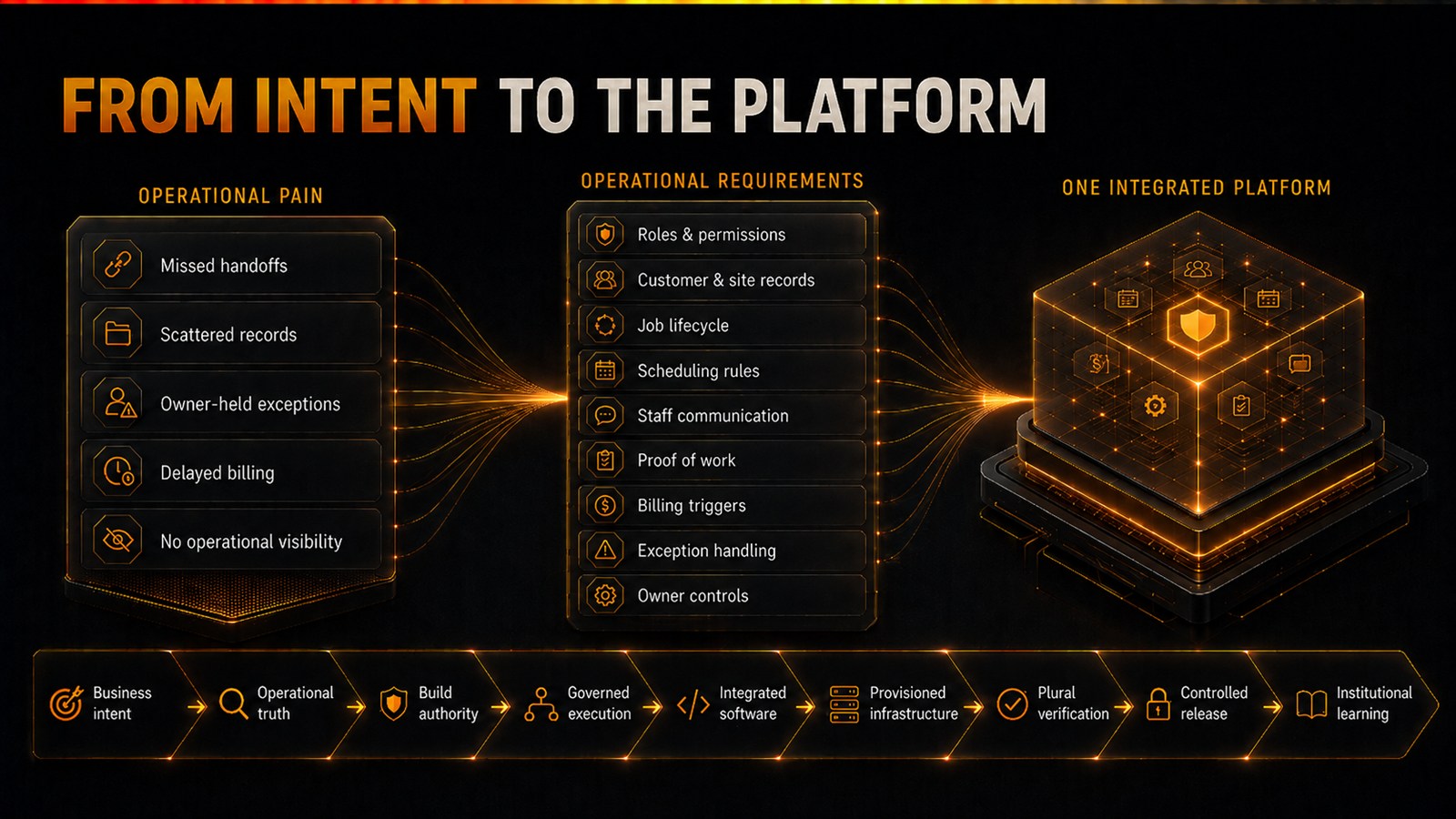
The commercial-services company does not need five disconnected apps and another collection of tabs.
It needs one platform that reflects how the operation actually works.
Sometimes the honest answer is simpler than that. When an off-the-shelf product genuinely fits the operation, buying it is the right engineering decision, and I have told owners exactly that. FoundryOS exists for the operation that does not fit the template: where the roles, records, handoffs and exceptions are the business, and forcing them into someone else's software means running the real operation in workarounds beside it.
Those requirements become canonical build authority. Architecture and plans derive from that authority. Specialized builders implement bounded parts of the system. Infrastructure is provisioned. Databases and providers are connected. Separate verification paths challenge the result. Release gates control the consequences. Project knowledge is refreshed after the work.
This is the path from intent to a platform the business can depend on. No single step on it is glamorous. Every step is the reason the one before it holds.
ENOUGH STRUCTURE FOR THE WORK
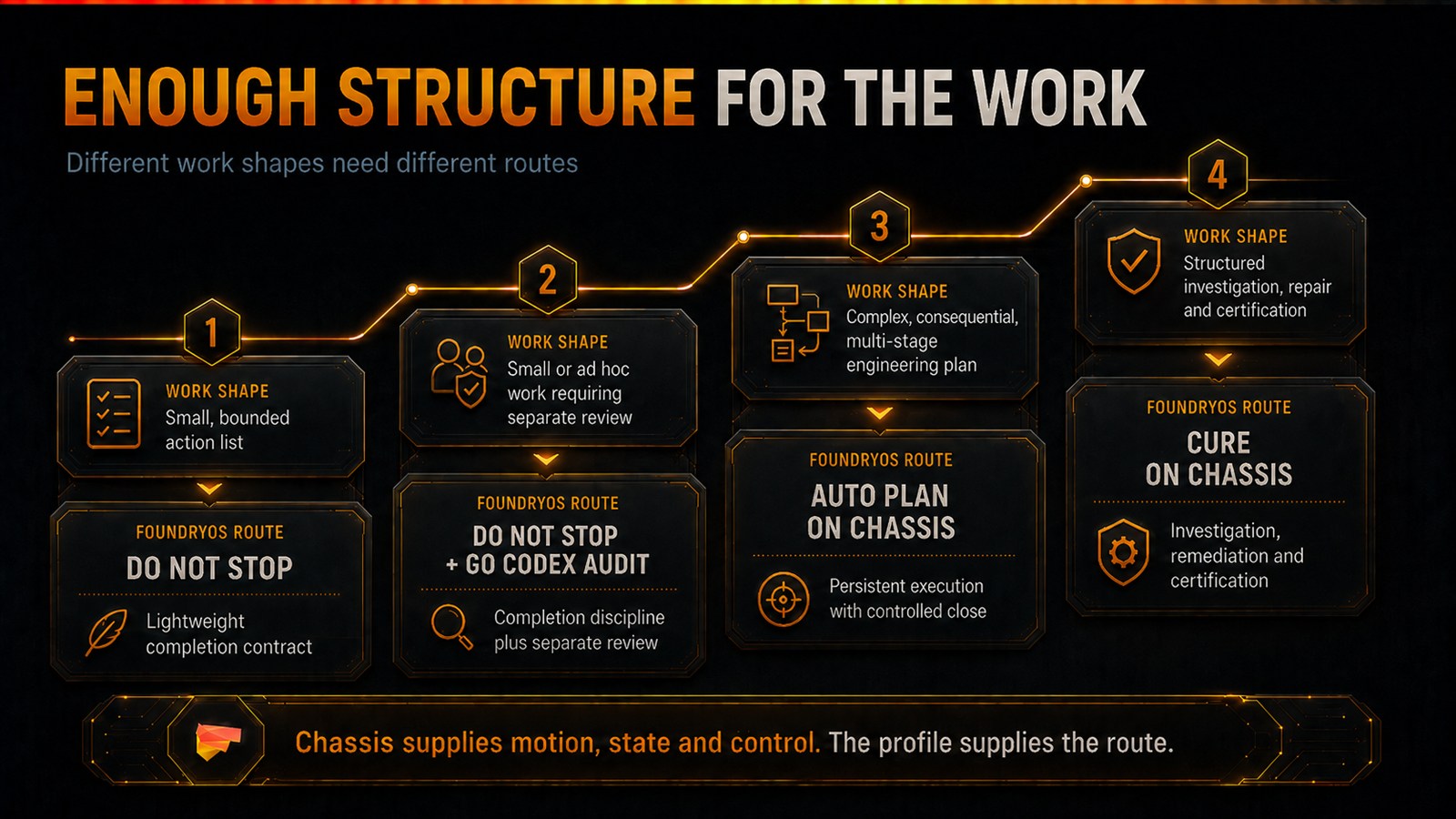
An automated department should not force every task through its heaviest process. Ceremony that exceeds the work is its own failure mode.
A five-item correction list does not need the same execution system as a multi-worktree capability build. A small branch may need separate review without needing a formal program. A running-system investigation has different requirements again.
The levels themselves are simple. Small work needs completion discipline. Reviewed work needs a separate set of eyes. Complex work needs persistent execution and a controlled close.
FoundryOS implements those levels through named routes.
| Work shape | FoundryOS route |
|---|---|
| Small, bounded action list | DO NOT STOP, a lightweight completion contract |
| Small or ad hoc work requiring separate review | DO NOT STOP plus go codex audit |
| Complex, consequential, multi-stage engineering plan | Auto Plan on Chassis |
| Structured investigation, repair and certification | Cure on Chassis |
A Codex review is a separate review pass. It evaluates work against its approved plan, pinned source and returned evidence rather than continuing the implementation itself.
Chassis is the reusable execution framework beneath the heavier lifecycles. It owns durable state, claims, retries, decision routing, handoffs, evidence and legitimate terminality. Auto Plan uses it for complex engineering work. Cure uses it for structured investigation and remediation. Smaller work runs on DO NOT STOP and the Codex audit path without invoking the complete lifecycle.
A platform like this one will need every one of these routes across its life. The first build is complex, consequential engineering. The correction list two weeks after launch is not, and it should not be treated as though it were.
Principle: Chassis supplies motion, state and control. The profile supplies the route.
The goal is not maximum ceremony.
The goal is enough structure to make the outcome dependable.
THE BUSINESS GETS MORE THAN AN APP
Return to the commercial-services company one last time.
The owner never really needed a dashboard.
The owner needed a platform where:
- Customer, site and service records have a clear source of truth.
- Staff see the work and information appropriate to their role.
- Scheduling changes propagate through the operation.
- Completed work produces evidence.
- Billing is triggered by the actual workflow.
- Exceptions remain visible instead of disappearing into chat.
- Owner-only decisions stay owner-only.
- Infrastructure and integrations exist outside the source code.
- Changes can be verified and released without relying on memory.
- Knowledge survives the person or model session that performed the work.
The interface matters because people have to use it.
The platform matters because the business has to depend on it.
The demo is the drawing. The platform is the building.
WHAT THE ARCHITECTURE PROVES, AND WHAT IT DOES NOT
FoundryOS contains real mechanisms, not only a conceptual diagram. It is worth being precise about what those mechanisms prove, and equally precise about what they do not.
To make the outcomes above dependable, FoundryOS relies on measurable machinery rather than an informal chain of prompts.
The values below were rechecked against current source on August 2, 2026. They must be regenerated on the publication date.
- 15 C-components.
- 169 registered Caliber criteria on a 334-point scale.
- 502 mechanically enumerated Crucible entries.
- Three active Chassis consumers, including Auto Plan and Cure.
Crucible is the knowledge base where engineering lessons are kept. Entries are written through a controlled collection path, deduplicated against the existing corpus and retained with their source context. Contradictions stay visible for resolution instead of being silently flattened. Converge analyzes catches and proposes codification, while control retirement remains an explicit operator-and-plan decision. The count describes a governed knowledge base, not a claim that every entry carries equal weight.
Those figures establish that the system exists and has substantial structural coverage. They do not prove every commercial claim someone might want to make about it.
The strongest current evidence is architectural and operational:
- The mechanisms are present in the repository.
- Important invariants are protected by hooks, schemas, tests, state machines and criteria.
- The system has been exercised in real FoundryOS and application work.
- Documented failures have produced documented remedies.
- Many remedies have been promoted into fleet-wide controls.
What the architecture does not yet establish: a universal productivity multiplier, a statistically measured reduction in defects, a complete replacement for every conventional engineering function, or portability across every technology stack and operator.
Those claims require defined baselines and broader evidence. I would rather earn them than assert them.
The honest claim is already significant:
Principle: FoundryOS coordinates business definition, engineering, infrastructure, verification, release and learning under explicit authority.
THE DEPARTMENT AROUND THE MODEL
The AI coding conversation usually starts with the model.
Which model writes the best code? Which one reasons longest? Which one can operate a computer? Which one can finish the largest task?
Those questions matter. They are no longer sufficient.
A business needs to know what surrounds the intelligence.
What establishes truth? What owns the plan? What controls access? What provisions the database? What verifies the running application? What prevents an unsafe release? What survives the session? What happens after the same kind of failure appears twice?
FoundryOS is what happened when I answered those questions in software instead of in promises.
The model is replaceable intelligence inside the system. The specifications, the controls, the infrastructure, the evidence, the project knowledge and the accumulated engineering lessons belong to the FoundryOS environment. Models will keep improving. The department keeps what it has learned.
The purpose of FoundryOS is not to make a model appear autonomous.
It is to make the business less dependent on luck, memory and rescue.
Keep reading
- Companion article — Inside FoundryOS: Component boundaries, execution architecture, evidence posture, and the CrewOS build trace.
- Field Note — DO NOT STOP!: The lifecycle contract that prevents premature agent termination.
- Field Note — The Chassis: The reusable execution framework behind durable autonomous work.
Evidence
Every incident and mechanism in this article traces to a sanitized evidence package — the claim, the supporting artifact, what it does not prove, the redactions, and how to reproduce it.
- Audit Chain Integrity — sanitized public excerpt · E1-C001 · E1-C002 · E1-C003 · E1-C004
- Prune Data-Loss (four-gate isolation) — sanitized public excerpt · E2-C001 · E2-C002
- Wrong root, false PASS — sanitized public excerpt · E3-C001
- CrewOS external-participant build — sanitized public excerpt · E6-C001 · E6-C002 · E6-C003 · E6-C004 · E6-C005 · E6-C006