Before & after: look inside a FoundryOS build
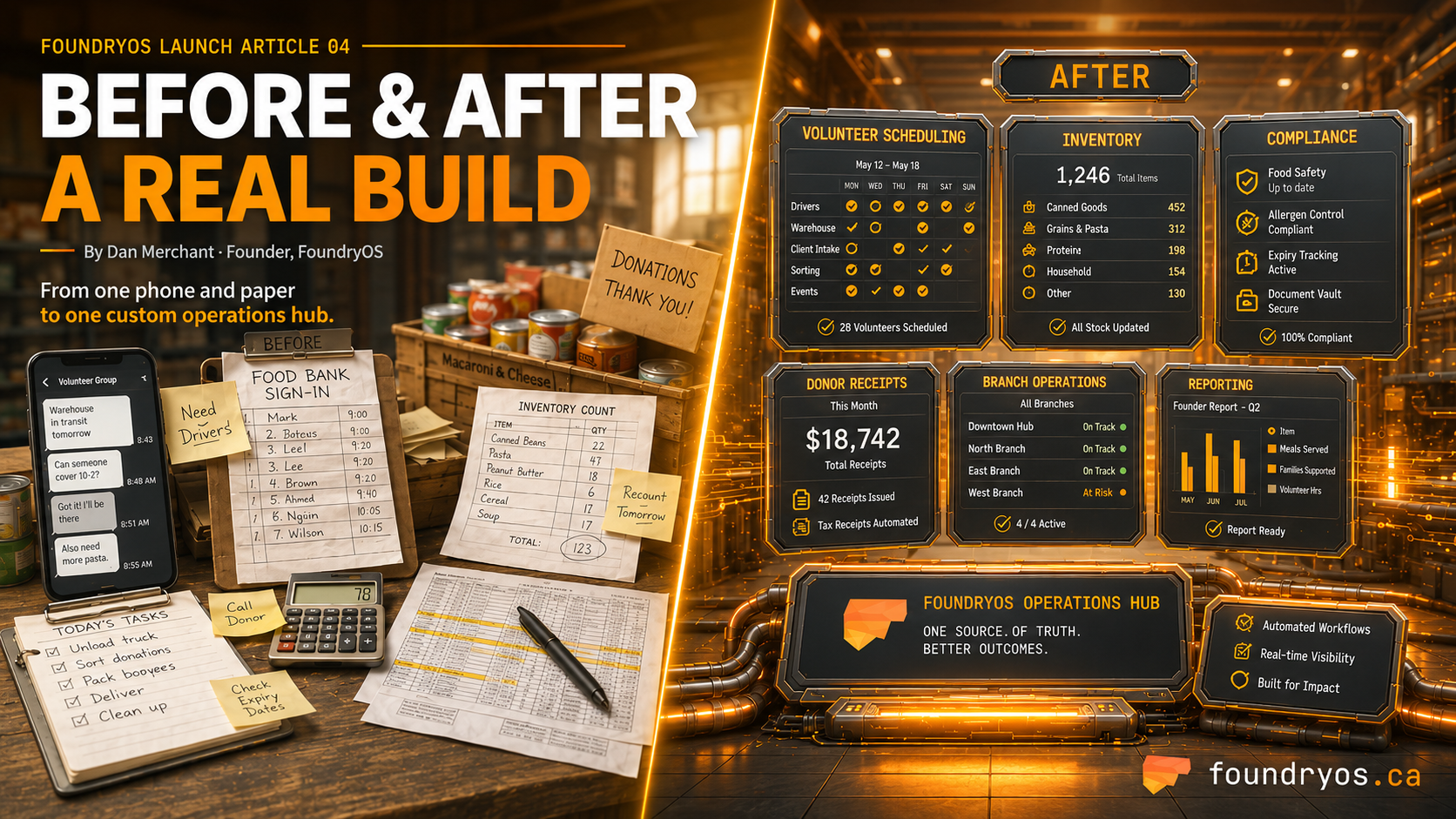
Before: a food bank run from one phone
A community food bank in Atlantic Canada was coordinating its entire operation from a single person's phone. One director held the whole thing together with text messages, a few spreadsheets, and a stack of paper. Food inventory was counted by hand. Funder reports were assembled at month-end from scattered logs. Volunteer coordination happened over text, with everyone sharing the same informal access. Compliance obligations — food safety, CRA, PIPEDA — were carried in one person's memory. It worked because she made it work, absorbing every gap herself. But that is a fragile way to feed a community: the knowledge lived in one head and one phone, and nothing scaled past her.
The build: one operations hub
FoundryOS replaced all of it with a single, custom operations platform — built around how a food bank actually runs:
- Role-scoped volunteer access — every person sees exactly what their job requires and nothing more. Access is designed and limited to each role — a market-day volunteer, a branch lead, a board member, the director — each with their own permissions, per page and per location, instead of one shared login and informal trust.
- Food inventory — every receipt, distribution, and wastage entry logged by source and category, with stock levels calculated automatically and low-stock alerts raised on the dashboard.
- Events & delivery scheduling — market days, pantry deliveries, and recurring routes on one shared calendar instead of a group chat that is always slightly out of date.
- Donor management with CRA-compliant tax receipts — receipts generated as PDFs straight from the donation log, audit-ready and consistent.
- Compliance management — food-safety, CRA, and PIPEDA checklists with document uploads, surfaced on the dashboard before anything lapses — not remembered, tracked.
- Funder reporting — Impact and CRA / T3010 reports assembled automatically from the same data volunteers enter day to day, instead of a month-end scramble from paper.
- Multi-branch operations — multiple locations and cross-branch food transfers managed from one system.
Ten-plus connected modules, one platform, shipped in weeks — an installable app that works on any device the branch already owns, even offline. Every visit a volunteer records counts itself toward the next funder report. Not a spreadsheet with a login — real engineering, built from scratch around one organization's operation.
After: the work stops living in one person's head
The change is not subtle. Coordination is centralized, routine counting and reporting are automated, and the operation has complete visibility for the first time. The director stopped being the integration layer between paper, phone, and spreadsheet — and started reading status instead of chasing it. The knowledge that used to live on one phone now lives in the system, where a volunteer, a board member, or a funder can see it. The friction that used to be absorbed by one person is now absorbed by the platform, which is exactly where it belongs.
Why it wasn't a heroic one-off
The temptation is to read a story like this as a lucky exception — the right person, the right cause. It is the opposite. The name FoundryOS is literal: a foundry casts raw material into finished, precision parts through a repeatable industrial process, and FoundryOS casts custom business platforms the same way. Because the process is engineered, the same speed, quality standard, and security rigor apply to every build — whether it is a volunteer-run food bank or a multi-department company.
What is FoundryOS?
Build, connect, integrate AI — Build what's missing, connect what already works, and integrate AI where it creates leverage. Use one, combine two, or bring all three together.
Ships in 2–4 weeks — A working, operational system in weeks, not the 6–12 months a traditional build takes.
AI-embedded — Intelligent automation wired securely into your daily operations — not a bolt-on chatbot.
All-inclusive ownership — Hosting, maintenance, support, and accountability included. One team, end to end. You own everything.
FoundryOS — we build, connect, and automate the systems your business runs on.
Tell us what your operation looks like today. We'll show you where to start — what to build, what to connect, what to automate — and how fast we can ship it.