For most software, "AI" now means a chat box in the corner of the screen. You type a question, it types an answer, and everyone agrees the product has AI. It is the least interesting thing artificial intelligence can do for an operation — and it has quietly lowered the bar for what businesses expect from it.
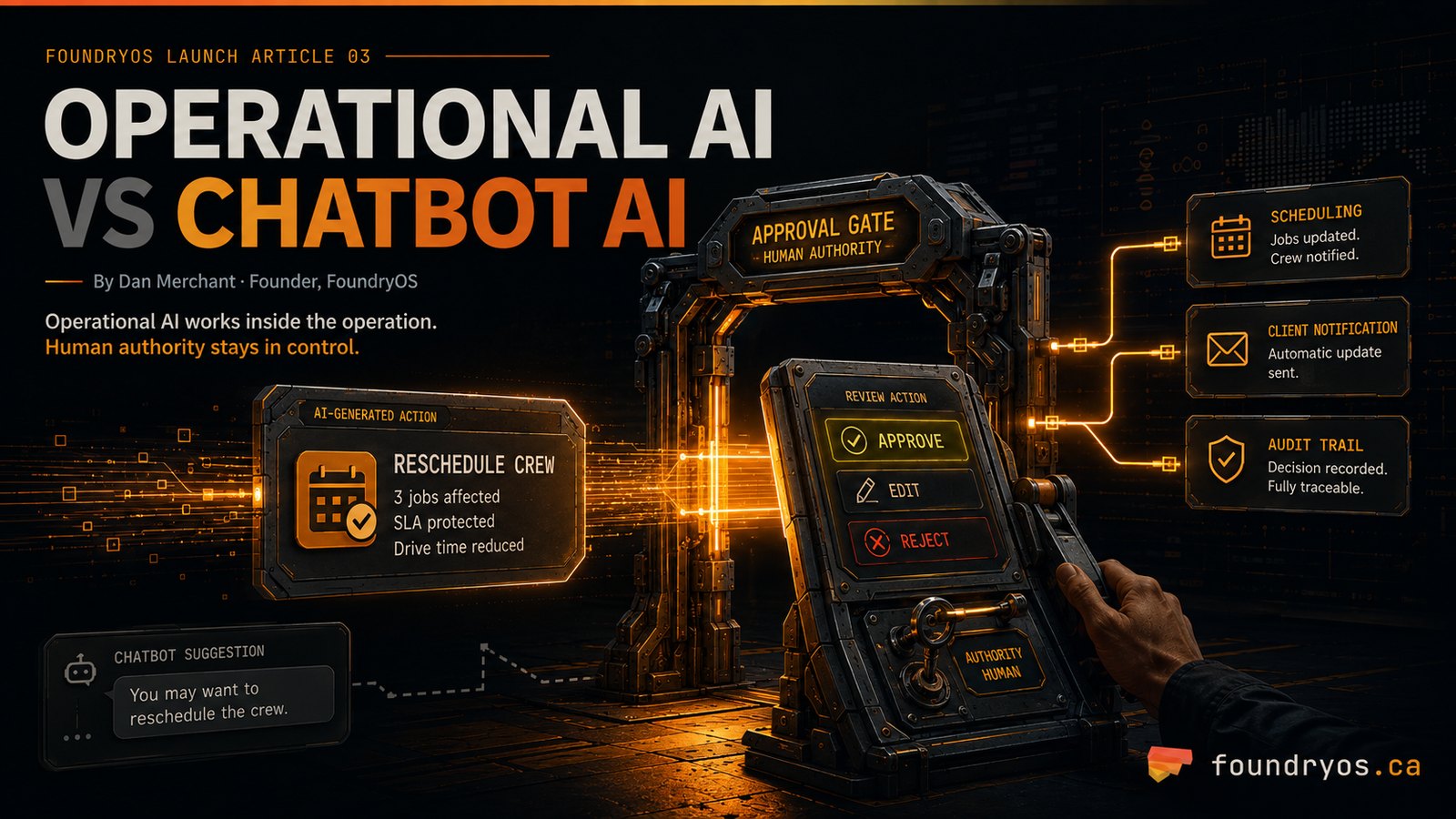
A chatbot answers. It sits outside your data and outside your rules, and when the conversation ends, nothing in your business changed. The quote still needs drafting. The appointment still needs moving. The overdue invoice still needs chasing. A chatbot can tell you those things exist. It cannot do them for you.
The distinction that matters
Operational AI does not sit beside your operation — it works inside it. It classifies, routes, schedules, drafts, and decides, against your live data, on rules you set, with a record of everything it touches.
The measure of operational AI is not how well it converses. It is how much real work it takes off your team's plate without taking away their control.
That last part is the whole game. Automation without governance is a liability. Nobody wants software making irreversible decisions in the dark. The useful version of operational AI is built around human-in-the-loop control from the start — the assistant proposes, a person approves, and the authority you hand it is something you dial up deliberately.
What this looks like in a shipped, custom platform
Examples running on FoundryOS today:
- CrewOS is a workbench that does the busywork. Ask in plain language to draft a follow-up, summarize a job, pull the list of overdue invoices, or reschedule — and the assistant proposes the action against live data, requiring human approval. A power tool, not a loose cannon.
- Scheduling that solves the tetris. The AI assistant reads the jobs, crews, drive times, and capacity rules and proposes a day that works. The final call stays with a human; the tedious part does not.
- Every action is a dial. Drafting, sending, scheduling, editing — each one can be switched on, set to require approval, or turned off entirely.
The pattern repeats across every build. For a recent commercial cleaning company, FoundryOS customized the following operations:
- An AI receipt scanner that reads photos taken on a phone to auto-fill employee expense reports.
- Daily scheduling with priority scoring and SLA awareness.
- A full governance layer underneath it all, with approval queues and an authority register.
Regardless of industry, the same principle applies: AI as infrastructure wired into the work, with a human holding the controls.
Why the difference shows up on the bottom line
A bolt-on chatbot is a feature you demo. Operational AI is capacity you keep. When the assistant drafts the message, fits the schedule, reads the receipt, and flags the exception — and a person simply approves — the work that used to consume your team's hours starts consuming minutes, and the judgment stays exactly where it belongs. That is the version of AI worth paying for, and it is the only version FoundryOS ships.
What is FoundryOS?
Build, connect, integrate AI — Build what's missing, connect what already works, and integrate AI where it creates leverage. Use one, combine two, or bring all three together.
Ships in 2–4 weeks — A working, operational system in weeks, not the 6–12 months a traditional build takes.
AI-embedded — Intelligent automation wired securely into your daily operations — not a bolt-on chatbot.
All-inclusive ownership — Hosting, maintenance, support, and accountability included. One team, end to end. You own everything.
FoundryOS — we build, connect, and automate the systems your business runs on.
Tell us what your operation looks like today. We'll show you where to start — what to build, what to connect, what to automate — and how fast we can ship it.