How does your business score on operational efficiency?
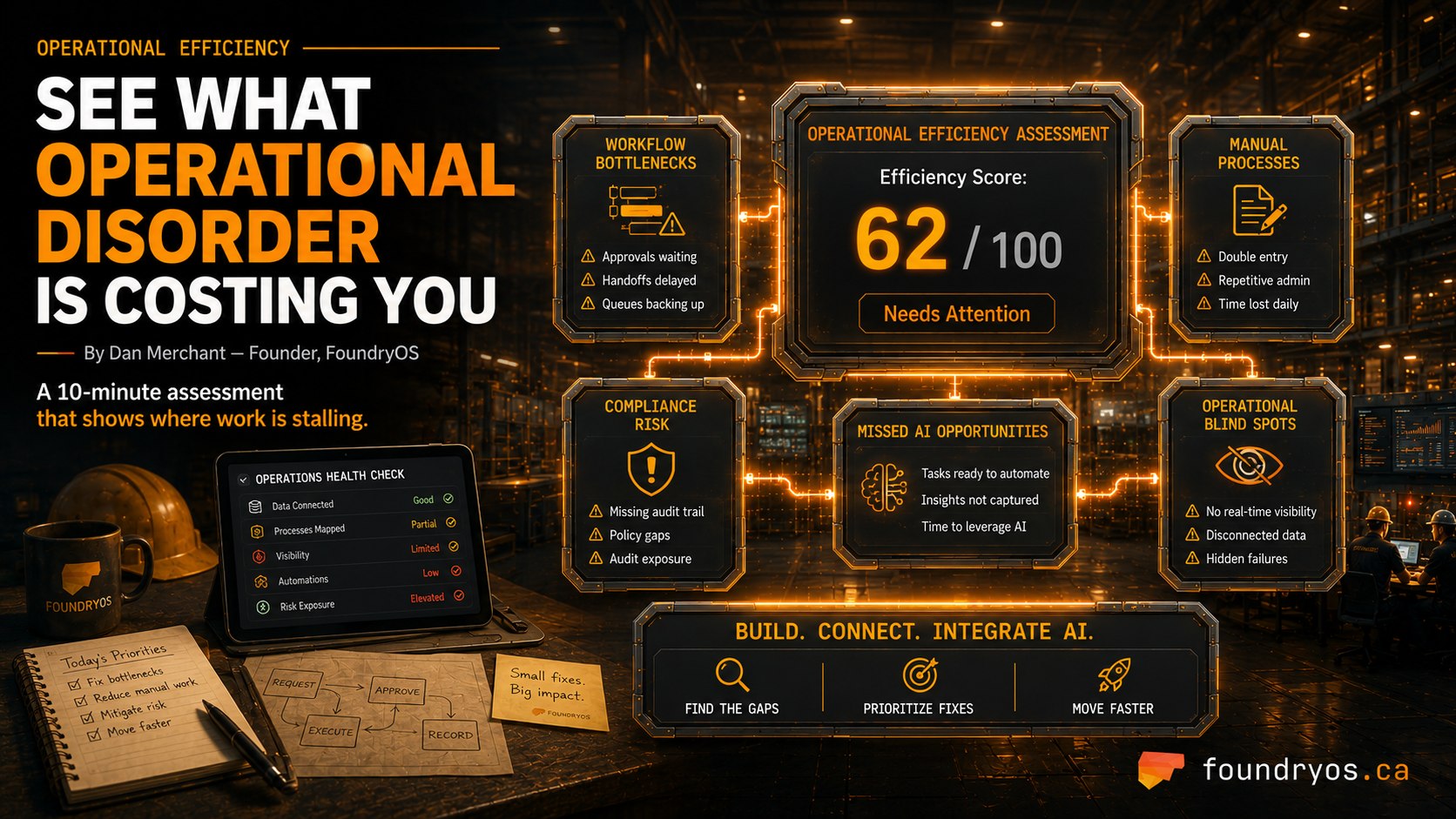
You score it across five dimensions: where work stalls, which tasks are still manual, where compliance gaps hide, where you have no real-time visibility, and where AI could close a gap today. Most businesses have never measured any of them.
The compounding cost of operational disorder is the most expensive line item you will never find on a P&L. It has no invoice, no vendor, and no budget line. It is the daily friction of work that stalls, repeats, and slips through the gaps between disconnected tools — and precisely because it is invisible, it goes unmanaged for years.
You cannot fix what you cannot see. Operational disorder hides in a predictable set of places:
- Workflow bottlenecks — the points in your day-to-day process where work stalls, repeats, or waits on a manual step that should not exist.
- Manual processes — the dated, repetitive tasks quietly consuming hours every week that AI or automation could eliminate outright.
- Compliance risk — the documentation gaps and vulnerabilities that stay invisible until the moment there is an audit or incident.
- Operational blind spots — the systemic weaknesses behind missed inspections, scheduling errors, and lost data.
- Missed AI opportunities — the places where an intelligent system could bridge a gap or help deliver missed opportunities.
In about 10 minutes, FoundryOS' Operational Efficiency Assessment identifies where work is stalling, which manual processes are ripe for automation, where compliance gaps are hiding, and where AI could close a gap today.
Take the Operational Efficiency Assessment →
What is FoundryOS?
Build, connect, integrate AI — Build what's missing, connect what already works, and integrate AI where it creates leverage. Use one, combine two, or bring all three together.
Ships in 2–4 weeks — A working, operational system in weeks, not the 6–12 months a traditional build takes.
AI-embedded — Intelligent automation wired securely into your daily operations — not a bolt-on chatbot.
All-inclusive ownership — Hosting, maintenance, support, and accountability included. One team, end to end. You own everything.
FoundryOS — we build, connect, and automate the systems your business runs on.
Tell us what your operation looks like today. We'll show you where to start — what to build, what to connect, what to automate — and how fast we can ship it.