The custom-platform era has begun
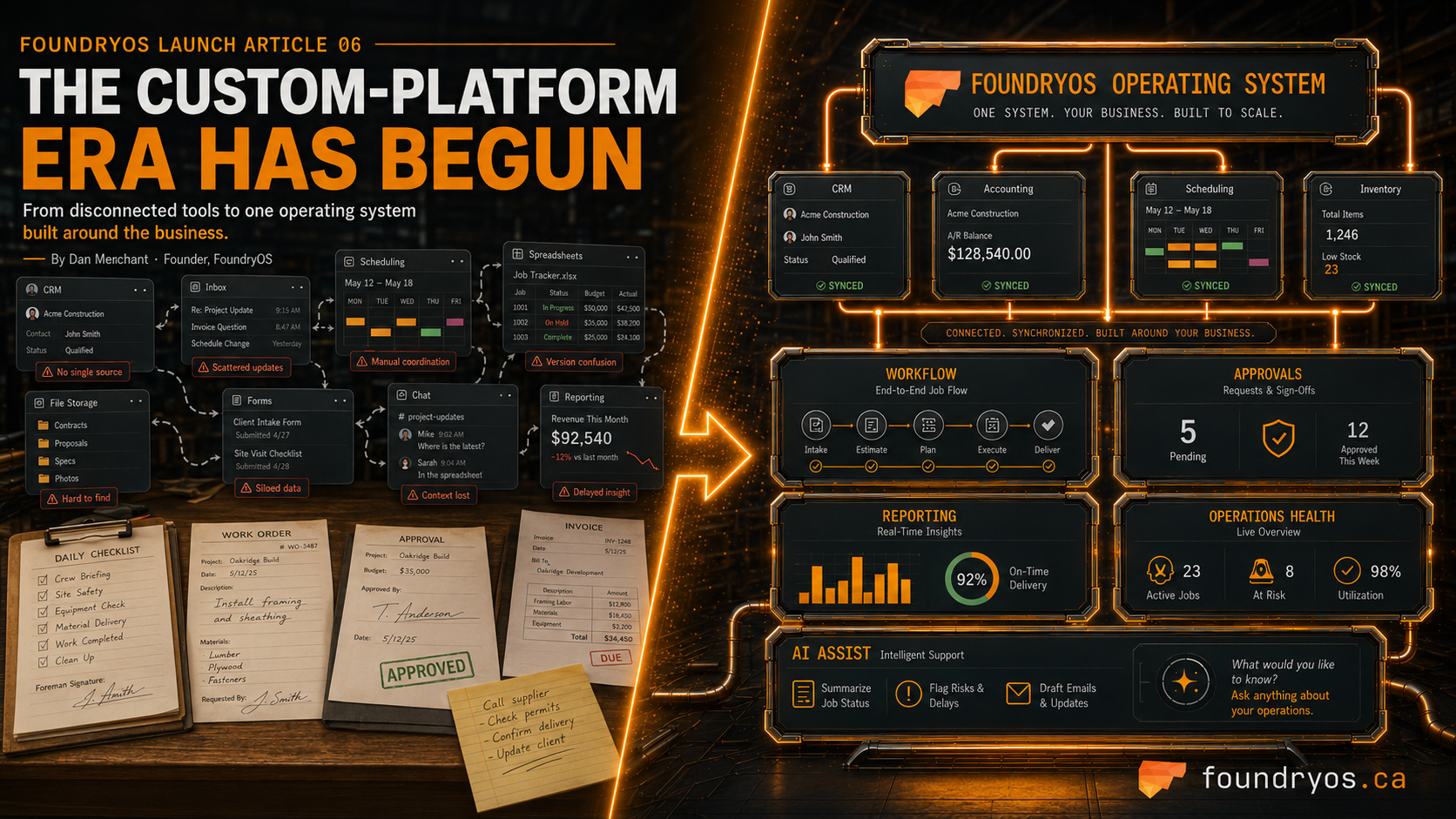
For thirty years, businesses have been digitizing themselves. Paperwork moved onto screens. Customer records, accounting, scheduling, projects, and communications moved into software. Today, even relatively small companies can have a dozen systems involved in running the business.
That changed almost everything, but it left one problem largely untouched: the business still must operate across all those systems. The CRM may manage customers perfectly well and the accounting software may do exactly what it should. The trouble starts in the space between.
That is the next layer of business efficiency.
We digitized the applications, not the operation
A business does not actually run inside a CRM, an accounting package, or a spreadsheet. It runs through the work that passes between them.
If your team is entering the same customer twice, chasing updates between departments, rebuilding reports from different systems, or relying on one person to remember what happens when something falls outside the normal process, you already know what this looks like.
That can work when a company is small. As it grows, information gets entered more than once, management loses visibility, and the workarounds start becoming part of the operating model.
A rational compromise
Large organizations have often invested in custom software around their own operations, and have done so for decades — commissioning internal systems, connecting specialized applications, and engineering workflows around operations. For everyone else, the economics usually did not work.
So businesses bought the closest available product, adapted the process to fit it, added another tool when necessary, and used people and spreadsheets to bridge whatever remained.
The tools were not necessarily the problem. The problem was expecting a collection of applications to become an operating system by itself.
A custom platform does not mean replacing everything
Modern cloud infrastructure, reusable software services, and AI-assisted engineering have dramatically increased what a capable team can produce. That does not make business software trivial, but it does give growing companies another option beyond adapting themselves to generic software or funding an enterprise-scale custom build.
And that option does not mean replacing everything.
If the accounting system works, keep it. If the CRM is doing its job, keep it. If an industry platform handles a specialized function well, there may be no reason to rebuild it.
The better question is: how should this part of the operation actually work?
Sometimes there is a missing system that should be built. Sometimes two good systems simply need to communicate. Sometimes the company already has most of the software it needs but no operating layer bringing the information together, structuring the handoffs, and giving management a clear view of what is happening.
We have already done exactly this: a community food bank in Atlantic Canada used to run entirely from one director's phone, a stack of paper, and a few spreadsheets. Today it runs on a single operations platform of ten-plus connected modules — role-scoped access, automated inventory and funder reporting, and complete visibility for the first time — shipped in weeks. You can read the full before-and-after.
That is why we describe the work at FoundryOS in three parts: build what is missing, connect what already works, and integrate AI where it creates real leverage.
This is where AI becomes operational
Most businesses have now seen what conversational AI can do. The larger opportunity begins when AI is connected to the work itself.
Inside a properly engineered business system, AI can know which customer, project, job, document, or transaction it is dealing with. It can operate against defined rules and permissions. It can know what it is allowed to propose, what requires human approval, and when a decision has to stay with a person.
That allows it to classify incoming work, route requests, prepare documents, surface exceptions, summarize activity, identify missing information, draft customer communications, and prepare defined actions for human approval.
Without operational structure, AI can talk about the business.
With that structure, AI can begin helping operate it.
This is the change FoundryOS was built around
FoundryOS started with the idea that custom business software did not have to remain an enterprise-only capability. Smaller organizations should be able to have technology shaped around how they actually work instead of constantly reshaping the business around the limitations of their software.
The exact solution will be different for every company, but the common thread is the operation.
Most businesses already have enough tools. The goal is to understand how the work actually moves — the handoffs, information, decisions, exceptions, reporting, and repetitive administration — and engineer the technology around that reality.
When that happens, information moves with the work instead of being chased after it. Handoffs become part of the system rather than a matter of memory. Operational knowledge becomes infrastructure instead of tribal knowledge. Management gains visibility without constantly asking for updates.
The people still make the important decisions. They just spend less time compensating for the technology around them.
That is the custom-platform era.
And it has already begun.
What is FoundryOS?
Build, connect, integrate AI — Build what's missing, connect what already works, and integrate AI where it creates leverage. Use one, combine two, or bring all three together.
Ships in 2–4 weeks — A working, operational system in weeks, not the 6–12 months a traditional build takes.
AI-embedded — Intelligent automation wired securely into your daily operations — not a bolt-on chatbot.
All-inclusive ownership — Hosting, maintenance, support, and accountability included. One team, end to end. You own everything.
FoundryOS — we build, connect, and automate the systems your business runs on.
Tell us what your operation looks like today. We'll show you where to start — what to build, what to connect, what to automate — and how fast we can ship it.